The galvanising process is a technique that is used to protect steel from corrosion for more than 250 years. Corrosion is caused by an inherent tendency of metals when subjected to air and moisture, which tend to return to their original earthly form, usually a state of mineral. They do it through a chemical or electrochemical reaction with the environment.
Galvanising consists of the immersion of steel parts in molten zinc to protect them from corrosion and enhance their mechanical strength against shocks and abrasion. Many confuse galvanising with zinc plating, and in fact many sources speak of them as synonyms, but these are different techniques, determined by the use that will be given to the material.
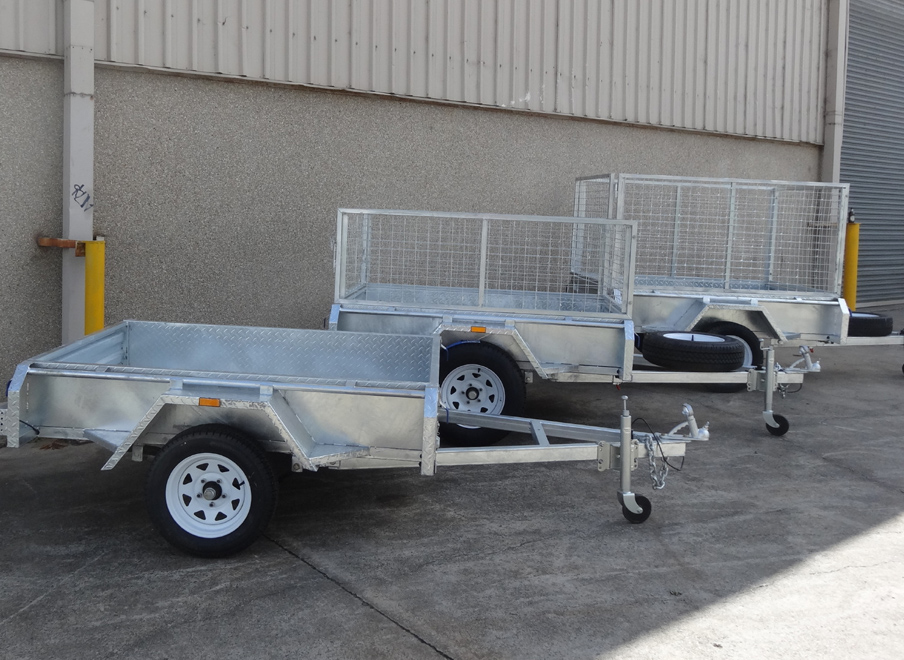
Here at Trailer Supplies we provide you with top quality galvanised trailers.
Galvanising process and zinc plating process
The galvanising process can be hot, immersion or fire. It consists of introducing molten zinc steel parts, at an approximate temperature of 450 ° C until a 7-42 micron coating (low coating, regulated by UNE EN ISO 10346) or 45-200 microns (high duration) is achieved, regulated by the UNE EN ISO 1461 standard). When zinc is metallurgically alloyed with steel, a layer is created that has great adhesion, is very resistant to shocks and is very hard, especially suitable for outdoor use and in humid or corrosive environments.
The zinc plating process is an electrodeposition process, similar to chrome plating or copper plating, also sometimes called (erroneously) cold galvanised, where the zinc layer is 5-20 microns, and is governed by the UNE EN ISO 2081 or UNE EN ISO 10152. Since this layer is thinner than galvanised, it is usually a suitable procedure only for interiors, and the pieces are softer and more uniform, increasing their aesthetic value. Therefore, sometimes we talk about small pieces of galvanised electronics, for example, when they are actually galvanised. If they go through a passivation process, however, the protection is increased, but they will not achieve the level of protection of the galvanised, unless they are especially expensive treatments.
Zinc Coating Types
As we have said, there are two ways of referring to zinc steel coating. The following are explained in more detail:
Zinc plated or electro-zinc plated
Zinc plating, or “cold galvanising” (which is more a marketing term than a real process) is simply to paint a piece of steel with zinc dust paint and special resins by means of a gun, brush or roller, which does not It will have the durability of hot dip galvanising in terms of abrasion resistance, cathodic protection and service life (or time until first maintenance). The cathodic protection offered by zinc-rich paint is inferior to hot-dip galvanisation because there are binders and other elements in the paint that limit the connectivity of zinc particles.
In order for this type of product to have a corrosion resistance equivalent to hot dip galvanising, it is required that the dry film contains a minimum of 95% zinc. In addition, it is necessary that the layer is conductive of electricity, only with these 2 characteristics is it able to protect the steel galvanically (cathodic protection). These requirements are regulated by ISO 8501.1, and for this reason, as zinc-rich paints do not meet them, they cannot be considered for galvanic protection.
Hot dip galvanised
Hot dip galvanising is the process of immersion of steel or iron manufactured in a boiler or bath of molten zinc. The process is inherently simple, which provides a distinct advantage in contrast to other corrosion protection methods. It is regulated by ISO UNE EN ISO 1461, which is the international standard for hot-dip galvanized coatings in iron and steel products.
The hot galvanising process phases
- Surface Preparation
- Galvanised
- Inspection
Surface Preparation
Surface preparation is a critical step in the application of any coating, whether galvanised, chromed, copper plated, etc. Most of the cases in which a coating fails before its expected useful life ends, are due to improper or inadequate preparation of the material surface. The advantage in the case of galvanizing is that it has a quality control inherent in its own process, since zinc is not alloyed on a dirty steel surface. At the time when uncoated areas are observed on the surface of the material when removed from the zinc bath, it can be known that it was not properly prepared and therefore corrective action can be taken immediately.
The surface of the steel to be galvanised is prepared in three phases:
- Degreasing or caustic cleaning: it involves the removal of organic pollutants such as dirt, paint marks, grease or oil from the metal surface by introducing it into a hot alkaline solution, a mild acid bath or a biological cleaning bath. In the event that the material has epoxies, vinyls, asphalt or welding debris, they must be removed by deburring or other mechanical means.
- Pickling: consists of the removal of the rolling scale and iron oxides from the surface of the steel by means of a dilute solution of hot sulfuric acid or hydrochloric acid at room temperature. It can be replaced or combined with the use of abrasive sand or sandblasting, metal blasting or sand on steel.
- Fluxado: it is the final step in the preparation of the galvanised surface, with ammonium chloride and zinc saline, to eliminate any remaining oxide and at the same time provide a protective layer to the steel so that other oxides are formed in the surface before immersion in molten zinc.
Galvanised
While submerged in the boiler, zinc reacts with the iron in the steel to form a series of metallurgically bonded intermetallic zinc and iron alloy layers, commonly crowned by a layer of pure impact resistant zinc.
The metallurgical reaction ends when the bubbling of molten zinc in the boiler stops. At this point, the galvanizing is complete and the steel is removed from the kettle to cool. Once the coating of the piece is completed, it is slowly removed from the galvanisation bath, and the excess zinc is removed by drainage, vibration and / or centrifugation.
The metallurgical reaction continues after the materials are removed from the bath, provided they remain close to the bath temperature. Galvanised items are cooled by immersion in a passivation solution or water or leaving them outdoors.
Inspection
Hot galvanized steel inspection is simple and fast. The two properties of hot-dip galvanised coating that are analysed in more detail are the thickness of the coating and the appearance / condition of the surface. A variety of simple physical tests can be carried out to determine the thickness, uniformity, adhesion and appearance of each piece.
If you want to know more about premium galvanised trailers in Australia, visit our website.