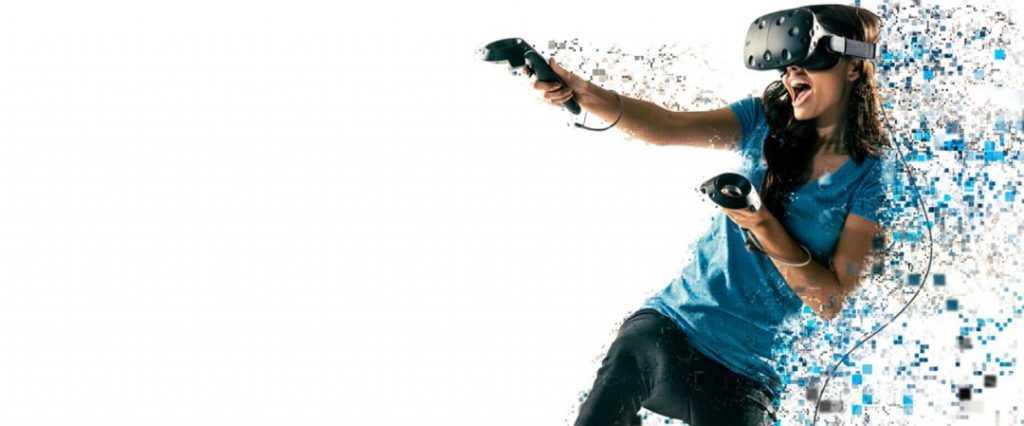
Virtual reality is a revolution setting bases for all fields where there are “impossible” scenarios that can be put on hands of people with the use of a technologic tool. Virtual reality has been an impressively big boom, there are many studies anticipating 2018 will be an excellent year for this tool, estimating up to 4,800 million dollars in earnings.
Although it has also been criticised, there are more people who see it as a revolutionary tool that can be used for avant-garde entertaining purposes and even a different educational approach. The long list of possibilities where VR (which is how Virtual Reality is commonly abbreviated) can be used keeps growing and growing, adding new files where it can be applied for practising knowledge and creating different scenarios in the most realistic way known up to date. Virtual reality has created a new paradigm that is so interesting as the popularisation of TVs 60 years ago.
Now that this tool is quickly establishing as one of the most solid options for the future, it is time to stop and think about the wide array of possibilities that should be taken into account in the near future. In the following article, different areas that may be “revolutionised” by virtual reality and its different uses will be evaluated. VR is considered the future of all technology in the educational field as well as for entertainment purposes.
Changing movies and filmmaking as we know it
Although the evident field where virtual reality will be indispensable in just a few years is videogames, there are many other fields that can be changed but may take a little longer for that to happen. Taking into account only 30% of the earnings from virtual reality commercialisation is the amount invested in development, its optimisation in other fields may take a while. Nevertheless, experts do not ignore the idea of movies seeing a radical change due to the implementation of virtual reality tools. The main concern regarding this are the limitations related to physical space inside a cinema.
According to experts, VR is the future and looks to bring a more familiar approach to movies. There have been some trials with people emulating participations in movies specially made for them, they are actually videogames or graphic novels where people need to successfully complete some specific challenges in rooms of over 200 metres square that allow them to move properly. These sessions have been tested with eight different players at the same time.
It is worth mentioning that one of the most successful scenarios is zombie apocalypse where people must kill zombies and hide from them in order to survive. Regarding the reception these games have had, they are highly appreciated for their capability to make people forget about problems while immersing a totally different reality.
According to experts, the best aspect about VR is that it can be an excellent tool to develop scenarios that where people need to collaborate in order to fulfil a specific task. Teamwork and synergy between co-workers, friends and colleagues are only some of the aspects that can be evaluated and strengthened. Thanks to internet connection it is possible to arrange tournaments and have different teams going against other teams, some experts state that this will become more popular during the next year.
Recording in virtual reality
On the other side, there are people who remain resilient to the idea of having virtual reality and its tools substituting classic filmmaking. According to filmmakers there is something in traditional cinema that will never cease to exist. This can be certified by many people who prefer to watch movies in common formant instead of 3-D movies which are so popular right now. “There is something about traditional movies… That feeling of complicity you share with everyone in the room where everyone is just another spectator.”
But something all people related to filmmaking and VR technology agreed on the new world of opportunities that filming in 360 degrees angles add to traditional filmmaking. Many agree that it is like learning something new. It is important to take into account framing from a different perspective, it is essential to take this into account during every single stage of the process, even while the script is being written.
It is considered impossible to adapt a script meant for a 2D movie to a VR movie.
Simulations and real-life scenarios
Setting aside entertainment, virtual reality has already established as a singular education tool that can be used for many different purposes. It can even be a powerful educational tool for little children since they can be totally immersed in the place they need to be in order to learn something specific.
However, this can also be an excellent tool for trainings and preparation processes. Virtual Reality has shown a lot of potential to emulate different conditions human beings may be submitted to in different jobs. For example, VR can be implemented during astronauts’ trainings in order to help them get familiar with the lack of gravity they will experiment in outer space, it can also emulate what “floating in the space” would be like along with many other situations.
As VR can help people get familiar with unusual situations, they can become an essential part of some training routines.
Right now, what we can do is wait for the surprises 2018 will bring to us in the field of VR innovation. VR tools are very likely to keep improving their performance in the educational field, becoming part of the resources used by teachers in many schools in the world, they will also keep evolving to become an essential part of entertainment, especially for areas such as videogames and graphic novels.
What many expert developers dream of is to find a way to connect VR to brain impulses, making space limitations not important since people will be able to “control themselves” only with their minds, not having to move or anything like that.