The world is constantly changing and evolving but, in recent years, the change in construction and architecture is even stronger than in other sectors. Possibly this is due, among other things, to the rise of the ideas of sustainability, energy efficiency and care for the environment for which we are surrounded today.
It will no longer be worth the most spectacular building or the most expensive or the highest building, it will also be necessary that the constructions are respectful with the planet, of quality and that consume little energy. The last excesses of construction in past years have done nothing more than underpinning this thinking and now architecture seems to be called upon to command that shift towards sustainability.
In this post we collect 7 very interesting materials that we may find in the architecture of the near future.
Synthetic tiles
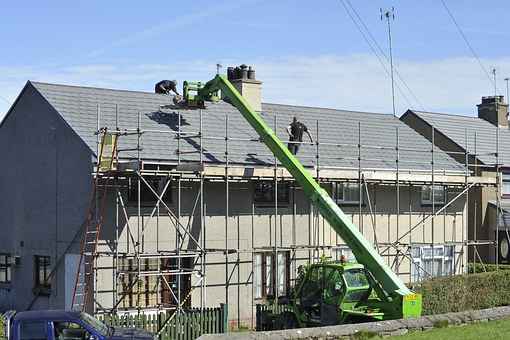
Synthetic tiles are made by recycled plastics and limestone, they are sustainable and around 50% cheaper than traditional ones. They have a lifespan of more than 50 years and are then 100% recyclable.
Another great option are photovoltaic roof tiles, in this case it is a more expensive product than the traditional one, but it ends up being profitable thanks to the energy generated.
Fibre and composite panels
These materials are a good alternative for enclosures, interior divisions and roofs. This option is extremely popular in Europe. these panels are formed by a combination of kevlar, fiberglass and carbon fibre that are 30% cheaper and 3 times more resistant than a traditional brick partition. It is a synthetic material, so it is immune to rodents and insects and this also makes it have a longer lifespan. Of course, it is efficient and totally ecological. It is insulating, resulting in energy savings of up to 50%, produces 100 times less waste than brick and is 100% recyclable.
Ecological bricks
It seems that we are determined to replace traditional bricks with any other material that is cheaper, more efficient and that contaminates the minimum possible in its production. Of course, bricks like tiles, seem to continue having the same shape and surely the same size. What is certain is that there are already several alternative solutions to traditional bricks made with clay.
A great example is that brick made by mixing water, earth and cement, compressing the mixture in a mould and letting it set naturally, without fire. With this process, up to 14 trees can be saved for each house built since wood is not used as fuel in the manufacture of the brick. By avoiding the cooking process, these bricks reduce greenhouse gas emissions by up to ten times compared to traditional baked bricks.
Pavement made with Biomason
Another interesting example is Biomason, an ecological brick that, although it seems incredible, is generated from microorganisms. It is an ecological alternative that does not release CO2 in its production and that is more economical, since it comes from natural resources. The Biomason brick is created at room temperature, feeding the microorganisms with materials such as sand and generating conditions in which they begin to produce crystals until, finally, they give rise to a brick.
Wood panels
Wood is a material that is very suitable for sustainable construction. There are wood panels that can be used directly as structural material. These are contralateral panels, formed by layers of wood arranged longitudinally and transversely, glued together, forming solid wood plates.
Wood is a better insulator than concrete, these buildings have a better thermal behaviour and are more energy efficient. Of course, the use of wood panels and their derivatives is not limited only to the structure of buildings but can be extended to interior partitions, facades, etc.
Resins and self-repairing concrete
Not all fields of research are focused exclusively on sustainability and energy efficiency. For example, University of Alicante has recently presented a transparent and flexible resin able to self-repair after being cut with scissors. Simply by putting the two parts in contact to re-join it in about 15 seconds. In addition, it also has shape memory, so whether it is crushed or manipulated, it regains its original shape in a few seconds. It is a material that is still experimental but that could have multiple applications in construction, such as in enclosures, building joints or even combined with other materials.
Along the same path have been researchers from the Technological University of Delft that has developed a bio-concrete capable of self-repairing. The process is reminiscent of the Biomason bricks. It consists of introducing into the concrete a new additive composed of small capsules containing bacteria and calcium lactate, when the capsules are broken (by the action of water that penetrates the cracks) the activity causes a chemical reaction that creates solidified limestone. In case there are cracks in the concrete, this process would be and fill those cracks. This bio-concrete has already been successfully tested by experts.
Solar paint
In this case, energy efficiency in construction is becoming little by little an obsession. Solar paint is still in development but, at the University of Sheffield, researchers have created the first spray capable of transforming any type of surface into a solar energy panel thanks to a mineral called perovskite, which has the property of absorbing sunlight. Its efficiency is 20% compared to 25% achieved by silicon solar panels, but this lower efficiency makes up for it with its easy application on practically any surface imaginable. Another advantage is the ability to generate power even in low light conditions and lower costs than the photovoltaic panel. Undoubtedly this painting would eliminate many barriers when it comes to the implementation of photovoltaic systems.
Many of these materials are already available but are either unknown or do not generate enough confidence among architects and builders. Here at Fire Crunch we are constantly innovating our practises and making buildings sustainable and fire-resistants. Our goal is also to protect and strengthen homes and properties from such unpredictable threats